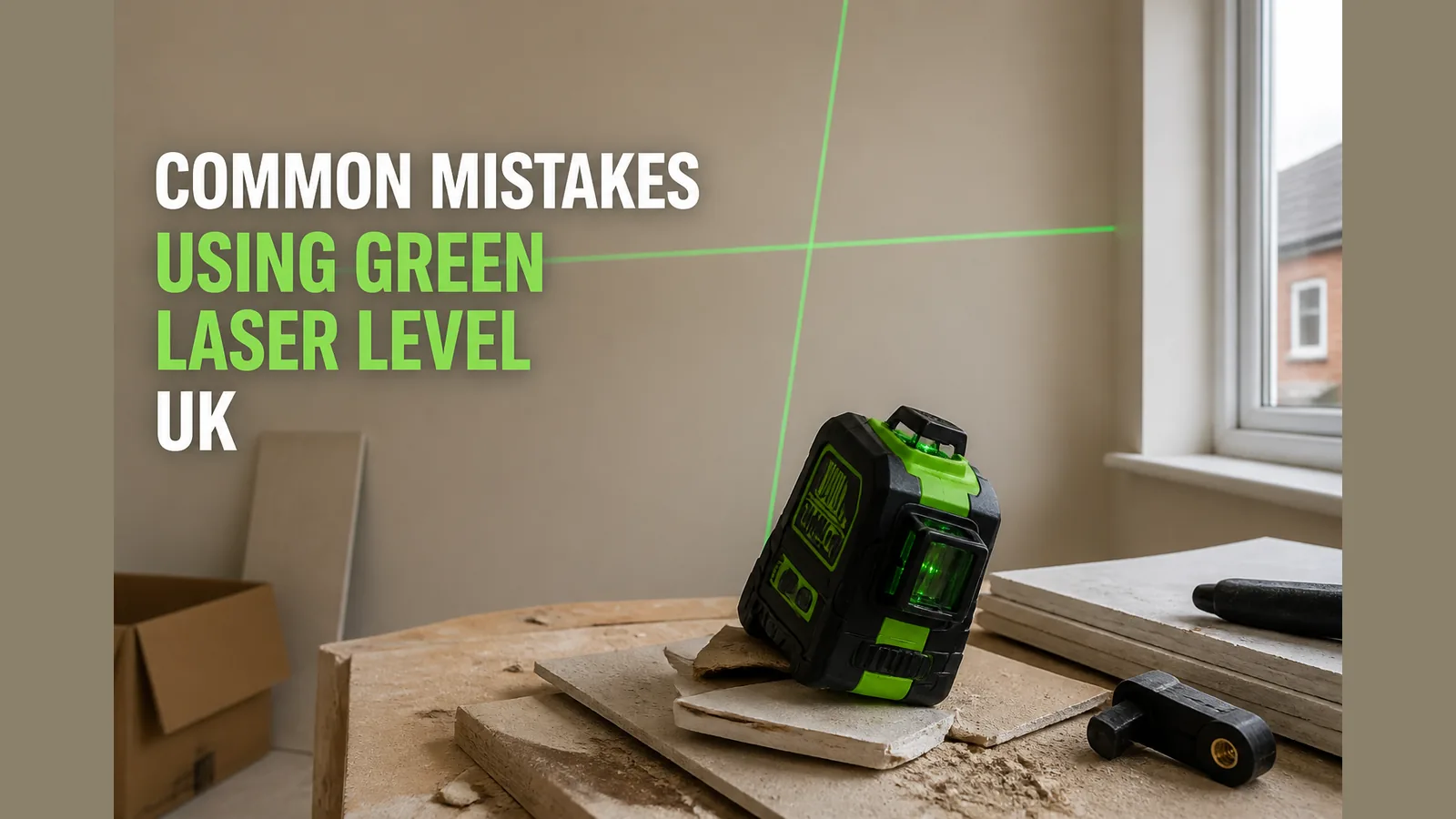
Common mistakes using green laser level UK: UK Practical Guide
The most common mistakes using green laser level UK jobs are simple: starting on an uneven or unstable base, ignoring self-levelling limits, trusting a beam that has not been checked against a known reference, and assuming a brighter green line means the tool is “more accurate” than set-up and calibration allow. Fix the set-up first, then decide whether the tool needs support.
Symptom → likely cause
When a green cross-line looks “off”, match the symptom to a likely cause before you change anything structural:
- Beam drifts or will not settle — the unit is outside its self-levelling range, the tripod or surface is moving, or vibration is keeping the pendulum moving.
- Lines look level in one place but wrong across the room — the base has shifted, the mount is loose, or the reference mark was transferred from an unchecked starting point.
- Green line is hard to see outdoors or in bright light — visibility limits, not necessarily a fault; colour helps in many interiors, but battery life, protection rating, self-levelling behaviour, and detector use still matter as much as beam colour.
- Results disagree with a spirit level or tape check — possible rough handling after transport, an unverified zero, or a check done on a short run that hides a small error.
Guides on frequent laser-level mistakes stress the same pattern: accuracy problems are often user set-up and process, not a mysterious “broken laser”.
Safe stop criteria
Stop marking, cutting, or fixing finishes if any of the following apply:
- The self-levelling mechanism will not lock into a steady state, or the unit keeps signalling out-of-level.
- The tripod, bracket, or floor point moves when you walk near it or adjust the height.
- Two independent checks (for example a known datum and a second reference wall) disagree by more than you can accept for the job.
- The housing has taken a knock, been dropped, or been stored loosely with other tools since the last reliable set-out.
- You cannot confirm the starting height or centre line against a fixed building reference.
Do not keep “nudging” the tool to force a line that will not settle. Pause, re-seat the base, and re-check from a known point.
What users can check
Before you assume a fault, work through these practical checks:
- Stable base — firm floor, locked tripod legs, and no soft packers that compress under the tool.
- Within self-levelling range — place the unit closer to level by eye; if it only works when forced, stop and re-mount.
- Clear beam path — remove dust, steam, and clutter that can scatter or fade the line.
- Simple calibration-style check — mark the line on a wall, rotate or reverse the unit carefully on the same spot if the design allows a fair comparison, and see whether the mark still agrees. UK buyer guidance for cross-line lasers routinely pairs green-versus-red advice with self-levelling explanation and calibration checks rather than colour alone.
- Battery and contacts — weak power can cause flicker or early shut-off that looks like a beam fault.
- Job lighting — in bright interiors, confirm whether you need shade, closer working distance, or a detector-compatible workflow rather than chasing a brighter appearance.
If you are comparing tools, remember that a clearer green beam in well-lit interiors does not replace checks on battery behaviour, ingress protection claims on the listing, self-levelling behaviour, and detector compatibility.
When to get support
Contact the seller or a competent service route when:
- The unit fails the same reference check after a careful re-mount on a stable base.
- Self-levelling never settles within the conditions you normally use for similar work.
- There is visible damage to the housing, window, or mount after a drop or heavy transport.
- You need confirmation against the listing facts for your exact model rather than guessed ratings or warranty wording.
Use confirmed details accuracy class, working range, IP rating, or warranty terms from memory. Use the product listing and official support channels for those details.
Next step
If you need a green self-levelling cross-line option for indoor set-out and want the product facts in one place, see the DEWALT DW088CG green self-levelling cross-line laser details before you buy or book support.
FAQ
Why is my green cross-line laser not accurate?
Most often the base is unstable, the unit is outside self-levelling range, or the starting datum was never verified. Common-mistake guides treat these process errors as the first place to look.
Is a green beam always better than red in the UK?
Green is often easier to see for day-to-day indoor set-out in brighter rooms, but colour is only one factor beside battery life, protection rating, self-levelling behaviour, and whether you need a detector.
What should I check before blaming the tool?
Confirm a solid mount, a settled self-level, a clear line of sight, adequate power, and agreement with a second reference mark. UK cross-line guidance also points to calibration-style checks as part of responsible use.
When should I stop work?
Stop if the beam will not settle, the mount moves, or two reference checks disagree. Fix the set-up or get support before cutting or fixing finishes.