Self Levelling Laser Level Explained: A UK Buyer's Guide
TL;DR
A self levelling laser level uses an internal pendulum to find true level on its own and then projects perfectly straight horizontal and vertical lines — no bubble-watching, no fine-tuning thumbwheels. Switch it on, let it settle for a few seconds, and you have a reference line you can trust for shelving, panelling and cabinet work. For home workshop use, the features that matter are a bright green beam you can see clearly, a simple one-switch operation, a pendulum lock for storage and a battery format you can replace from the kitchen drawer.
Key Takeaways
- A self levelling laser level uses an internal pendulum and magnetic dampening to project true plumb and level lines automatically, within a set compensation range.
- If dim red lines have become harder to pick out — a common frustration as eyes age — a green beam makes an immediate, practical difference.
- Setup is genuinely simple: place it, switch it on, wait a few seconds. If it is too far out of level, it warns you rather than projecting a false line.
- A pendulum lock protects the mechanism between uses — worth having on any unit that lives on a workshop shelf.
- AA-powered models keep running costs and faff to a minimum: no proprietary charger, no dead battery pack mid-project.
A self levelling laser level is designed to find true level and plumb automatically, so you can project accurate horizontal and vertical reference lines without adjusting the tool each time. That means quicker set-out and fewer errors whether you are hanging cabinets in the garage workshop, fitting wainscoting up the hallway or getting a long run of shelving dead level first time.
Precision has a way of deciding how satisfying a finished job looks. A shelf that runs a few millimetres out over two metres, or panelling that drifts off plumb by the far corner, is the kind of error a spirit level lets through one section at a time — each repositioning is another chance to compound the drift.
The self levelling laser has moved from specialist site kit to everyday workshop tool for exactly that reason. This guide explains how the mechanism works, where the tool is most useful at home and on site, and which features matter when choosing one.
What Is a Self Levelling Laser Level?
A self levelling laser level is a precision tool that projects straight reference lines by automatically correcting itself to true horizontal and vertical within its operating range. In simple terms: place it on a reasonably flat surface or tripod and it levels itself, without any manual fine-tuning.
How Does a Self Levelling Laser Level Work?
Inside the casing sits a sensitive pendulum suspended on a gimbal. Gravity pulls the pendulum into a true plumb position, and the laser diodes attached to that mechanism project straight lines across your workspace.
Left to itself, a swinging pendulum would take too long to settle — so manufacturers use magnetic dampening. Magnets positioned around the pendulum calm the swing almost immediately, which is why a good unit is ready to work within a few seconds of being switched on.
What Is the Compensation Range?
Most professional units self-correct within roughly ±3 to ±4 degrees of level — the DEWALT unit we stock states ±4°. Inside that tolerance, the pendulum finds true level on its own. Outside it, the device warns you by flashing its beams or sounding an alert rather than projecting a false line. That fail-safe is the feature that protects a whole afternoon's work from one careless setup.
Why Use a Self Levelling Laser Level?
The cost of working from a bad line is real even outside professional sites. Research from the Get It Right Initiative (GIRI) puts the direct cost of avoidable error in UK construction at around 5% of project value — approximately £5 billion a year, with estimates rising to £10–25 billion once indirect costs are included. In a home workshop, the currency is different — wasted boards, re-drilled fixings, a weekend spent redoing Saturday's job — but the lesson is the same: errors compound from the first line.
Older British houses sharpen the problem. Floors dip, walls bow and corners drift out of square over the decades, so measuring up from the floor or across from a window reveal quietly imports those errors into your work. A laser gives you one honest datum across the whole room, independent of whatever the house has settled into.
There is also a plainer reason woodworkers reach for one: working alone. A projected line is a second pair of hands — it holds the height across the wall while you drill, and it does not slip when you look away.
What Features Should You Look For?
A Beam You Can Actually See
The human eye is markedly more sensitive to green light than red, so green beams appear brighter and stay readable across a well-lit garage or conservatory-bright room. If you have noticed dim red lines getting harder to pick out against timber and pale walls, green is the single upgrade that changes the experience. The full comparison — wavelengths, battery trade-offs, spec checklists — is in our green line laser level guide.
Cross Line Projection
Most self levelling units in this class project a cross: one horizontal and one vertical line meeting at 90 degrees, which is ideal for shelving runs, cabinet stacks and panelling grids. What the cross line format can and cannot do as a category is covered in our cross line laser level guide.
A Pendulum Lock for Storage and Transport
The gimbal mechanism is delicate enough that vibration and knocks can affect calibration over time. A pendulum lock secures the mechanism when the unit is off — a small feature that matters for a tool that lives on a shelf between projects and rides in a car boot to the timber yard.
Sensible Power and Protection
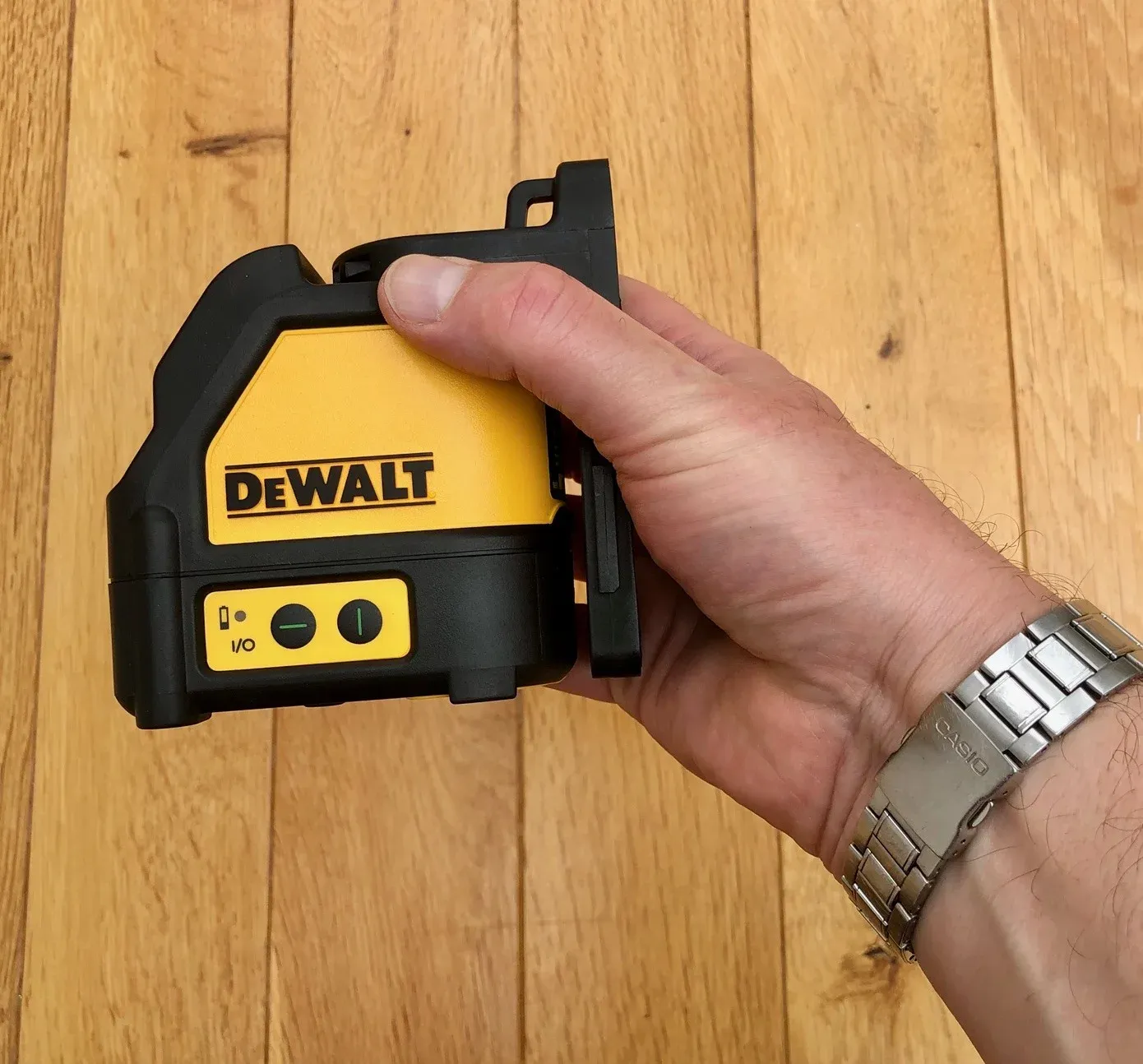
An IP54 rating keeps dust and splashes out — sawdust counts. On batteries, AA cells have a quiet advantage for occasional use: no proprietary pack to lose charge on the shelf, no charger to find. The DEWALT DW088CG-XJ we stock runs on 3×AA batteries, included in the box.
Can You Use a Self Levelling Laser Level Outdoors?
Yes — but in daylight, not by eye. Sunlight washes out any visible beam over distance; the answer is pulse mode paired with an electronic receiver, which reads the beam the eye cannot see. If decking, fencing or garden levels are on your list, our laser level with detector guide explains that workflow. For indoor workshop and around-the-house work, the visible line is all you need.
Is a Self Levelling Laser Level Worth It?
If your projects run to shelving, cabinets, panelling and the occasional room refresh, yes — automatic levelling removes the most error-prone step and makes solo work noticeably calmer. If your ambitions stop at hanging a mirror once a year, a decent spirit level still earns its keep and costs a great deal less.
For those who want one good tool rather than a drawer of compromises, the DEWALT DW088CG-XJ green cross line laser at £421.47 pairs the self levelling pendulum described above with a bright green beam, ±0.3 mm/m stated accuracy, IP54 protection, an integrated magnetic base and a carry case — with free UK next-day delivery on orders over £50 and 30-day returns.
Frequently Asked Questions About Self Levelling Laser Levels
What is a self levelling laser level used for?
Projecting accurate horizontal and vertical lines for tasks such as shelving, cabinet installation, panelling and wainscoting, stud wall layout, tiling and kitchen fitting — anywhere a straight, level reference saves repeated measuring and marking.
How accurate is a self levelling laser level?
Professional units state their tolerance clearly — the DW088CG-XJ specifies ±0.3 mm per metre. Over a three-metre shelving run, that is a deviation of around a millimetre: tighter than any bubble vial read by eye.
Do I need to calibrate it before each use?
No. Within its compensation range the pendulum finds level automatically each time you switch on. Treat it gently — use the pendulum lock in transit — and check it occasionally against a known reference; if it ever warns persistently or the line looks off, have it checked rather than working around it.
Will the batteries die mid-project?
AA-powered units give you the easiest answer: keep spares in the workshop drawer and a battery change takes under a minute. No charger, no proprietary pack, no waiting.
Ready for a line you can actually see?
Shop DEWALT DW088CG-XJ — £421.47